Nursing Playbook / A working session
Compare the role behind the description.
Work through two fictional first-role options, separating confirmed details, open questions and the constraints that matter to you.
Compare the information you have, then the questions you need
Two attractive role descriptions can leave very different questions unanswered. Before assigning a winner, separate confirmed terms from advertised descriptions and personal assumptions. A precise list of unknowns is more useful than a score built from guesses.
This session compares two invented opportunities for a fictional applicant. It does not rank hospitals or recommend accepting an offer. Use current employer information and your own constraints; obtain appropriate advice for contractual or financial questions outside this preparation exercise.
The working case: Rowan's two options
Rowan is a fictional new graduate comparing two roles. Rowan has a recurring evening commitment on Wednesdays and needs to understand whether each schedule could accommodate it. Neither option has confirmed that point.
The fictional Cedar role describes rotating shifts and scheduled learning reviews, but does not identify who conducts them. Its recruiter confirms the campus. The fictional Harbor role describes nights and names a contact for orientation questions, but the invitation does not specify the campus assignment. Rowan has not received complete written terms for either role.
On a narrow screen, scroll the table sideways to read each column.
| Question | Cedar: evidence available | Harbor: evidence available |
|---|---|---|
| Where is the role? | Campus confirmed by recruiter | Campus assignment not yet stated |
| What schedule is described? | Rotating shifts in posting | Nights in posting |
| How is learning discussed? | Scheduled reviews described; reviewer unknown | Orientation contact named; review structure unknown |
| Does it fit Wednesday evenings? | Not confirmed | Not confirmed |
The table does not award points for the number of completed cells. Cedar's confirmed campus may be useful, but it does not answer Rowan's scheduling question. Harbor's named contact makes a question easier to direct; it does not prove that its support is better.
Turn the gaps into precise questions
For Cedar, Rowan can ask: “The posting describes rotating shifts. How is the schedule determined for this role, and what should I understand about recurring availability constraints?” Rowan should explain the actual constraint where appropriate rather than hoping the word “rotating” means it will fit.
For Harbor: “Could you confirm the campus assignment for this requisition and who can explain the scheduling expectations?” That question resolves the location before Rowan estimates a commute to the wrong place.
For learning support, either employer could be asked how new-graduate progress is reviewed, who participates and what happens when more support is needed. Use the nurse-manager questions guide to develop follow-ups. A favorable answer is still information to understand, not a guarantee of an individual experience.
Show how new information changes the record
In the next fictional conversation, Cedar explains the scheduling process but cannot confirm an accommodation before further discussion. Rowan updates the cell to “process explained; Wednesday constraint unresolved.” That is progress in understanding, even though it does not settle the decision.
Harbor confirms its campus in writing. Rowan can now investigate the journey from home using the actual location and relevant travel times. The worksheet should record that location source separately from Rowan's own travel estimate. A possible commute on one day does not establish that every shift will be practical.
Neither update justifies calling an option “best.” Rowan still needs to decide which uncertainties must be resolved before proceeding and which preferences allow flexibility.
Put your constraints beside the comparison
In the blank worksheet, distinguish a requirement you cannot change from a preference you can discuss. Be specific enough to use the distinction. “Supportive workplace” is an aspiration; “understand who I can approach when I need learning support” is a question an employer can answer more concretely.
Keep compensation, benefits, start conditions and any obligations tied to the written information you actually receive. Do not fill absent terms from another employer's offer or an online account. This session does not interpret contracts or calculate which offer is financially superior.
Leave with a decision to investigate
Write the two highest-priority unresolved questions, the appropriate contact for each and the information that would change your next step. If only one role is available, use the same method to evaluate it against your needs; you do not need a second offer to ask careful questions.
Use the first-role comparison guide for a shorter review. If a role remains worth pursuing, carry its application requirement into the application desk. Keep the worksheet private; it does not accept, reject or negotiate an offer.
If you need the wider process
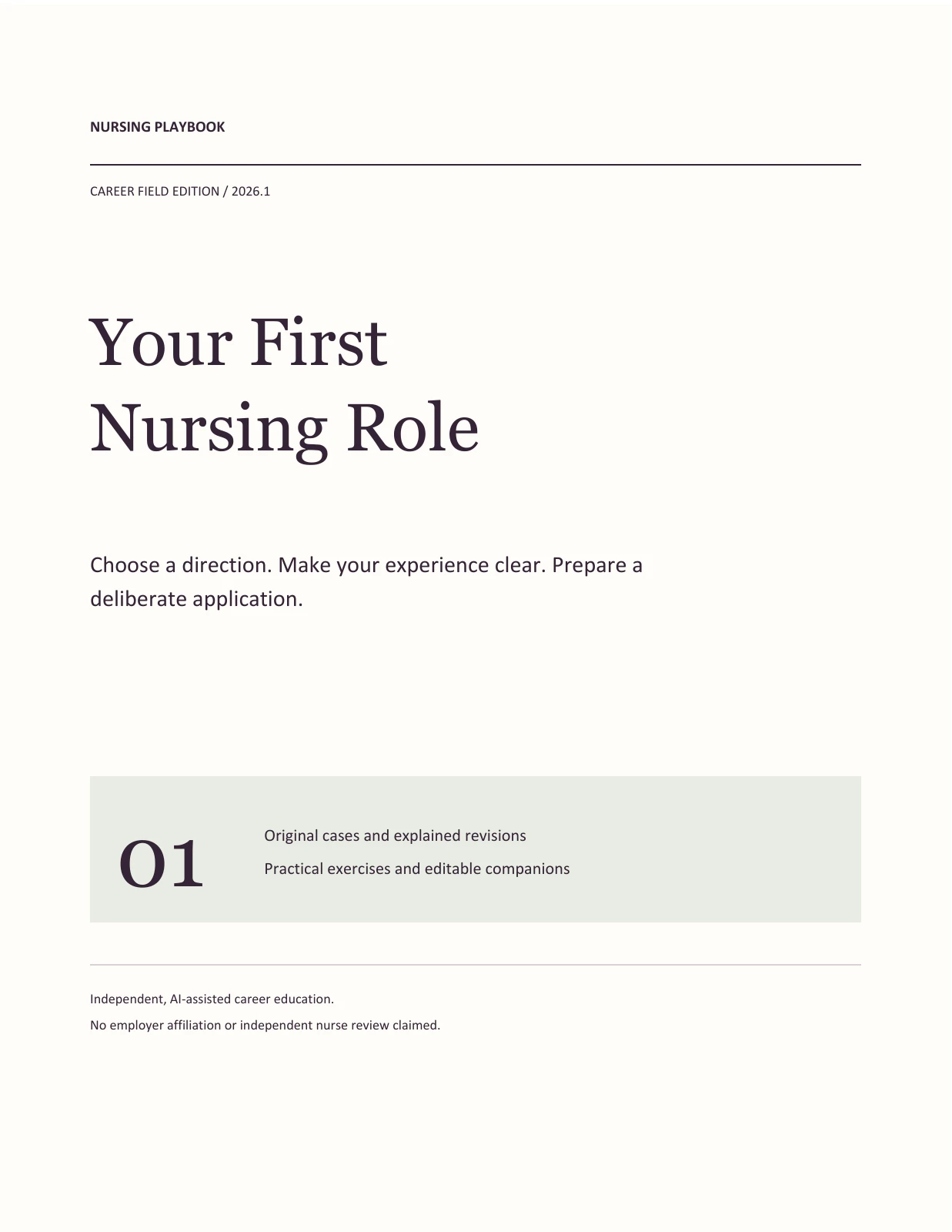
Your First Nursing Role
The field guide carries the comparison into a target brief, evidence inventory, resume and application plan. Four editable companions help you keep that work together.
36-page PDF · 10-page free preview · Edition 2026.1
$29 USD one-time price. See the product page for current availability.
The free worksheet above is useful on its own. The book is self-directed career preparation; it does not include a personal review or determine eligibility.