Nursing Playbook / A working session
Build an answer that survives a follow-up.
Work from a factual experience record to a clear answer, then practice questions about your contribution and what happened afterward.
Keep the experience steady as the questions change
An experience-based answer should remain accurate when someone asks what you personally did, what changed and what you learned. This session starts with a small factual record, develops an answer and then checks it against two follow-ups.
The case and prompts are original fictional practice. They are not questions supplied by an employer or a clinical assessment. Use your own experience and answer the question actually asked in a real interview.
The record before the answer
Nadia is a fictional nursing student who helped prepare a group presentation. Her responsibility was to combine the team's sections into one document and check the submission instructions. Two days before the deadline, one section was missing a source citation and another used an outdated version of the assignment outline.
Nadia messaged the two contributors with the specific gaps and the current instructions. One teammate supplied the citation; the other revised the section. Nadia assembled their changes, checked the headings and submitted the file through the course portal. The group received a submission confirmation. No grade or instructor assessment is part of this record.
Before speaking, Nadia writes a short evidence sheet:
On a narrow screen, scroll the table sideways to read each column.
| Part of the experience | Supported fact | Limit to preserve |
|---|---|---|
| Responsibility | Assemble the document and check instructions | She did not author every section |
| Action | Identify gaps, contact contributors and check the combined file | Teammates supplied their own corrections |
| Outcome | Submission confirmation received | No grade or quality judgment yet |
This is the material available for the answer. Adding a compliment, a grade or a claim that she rescued the team would change the story.
First attempt, then a more useful answer
The original practice prompt is: “Tell me about a time you helped a group complete a task.” Nadia's first attempt is:
“I led the team, fixed everyone's mistakes and made sure we got an excellent result.”
It is short, but it overstates both her authority and the outcome. A revision could be:
“For a group presentation, I was responsible for assembling our sections and checking the submission instructions. Two days before the deadline, I found a missing citation and a section based on an older outline. I sent each contributor the specific issue and the current instructions. They revised their sections, and I checked the combined document before submitting it. We received the submission confirmation. I would build in an earlier shared check next time so those issues are easier to resolve.”
The answer preserves the shared work. Its final sentence is Nadia's proposed improvement, not a claim that the group later adopted a new process.
Follow-up one: separate the contributions
The practice interviewer asks: “What did you change yourself?”
Nadia can answer: “I identified the gaps, sent the instructions and assembled and checked the revised document. The contributors made the changes within their own sections.” She does not need to repeat the whole story. The follow-up asks for a boundary, so her answer supplies it.
For your own example, underline every “we.” Keep it where the action was shared, and add your personal action where the listener would otherwise have to guess. Do not replace every “we” with “I”; that can create a different inaccuracy.
Follow-up two: limit the outcome
The next question is: “How did you know the work was successful?”
Nadia's record supports: “I could confirm that the file was submitted. We had not received the grade at that point, so I could not yet say how the work was assessed.” That answer is narrower than the first draft, but it matches the evidence.
In a real experience, you may have more outcome information. Use it if it is accurate and relevant. If you do not, distinguish the completed action from a result still unknown.
Run your own revision
Download the worksheet and write the record before the speech. Say the answer aloud, then ask a listener to identify your responsibility and the supported result. If working alone, compare what you said with the written record after speaking.
Choose one revision: remove an unsupported outcome, clarify a shared action or shorten background that obscures the answer. Repeat only the affected part before trying the full answer again. This is a practice observation, not a score of nursing competence or hiring readiness.
For another setting, read the feedback example. Use the rehearsal room to organize your own draft, or move to the panel session to practice responding when the conversation changes direction.
If you need the wider process
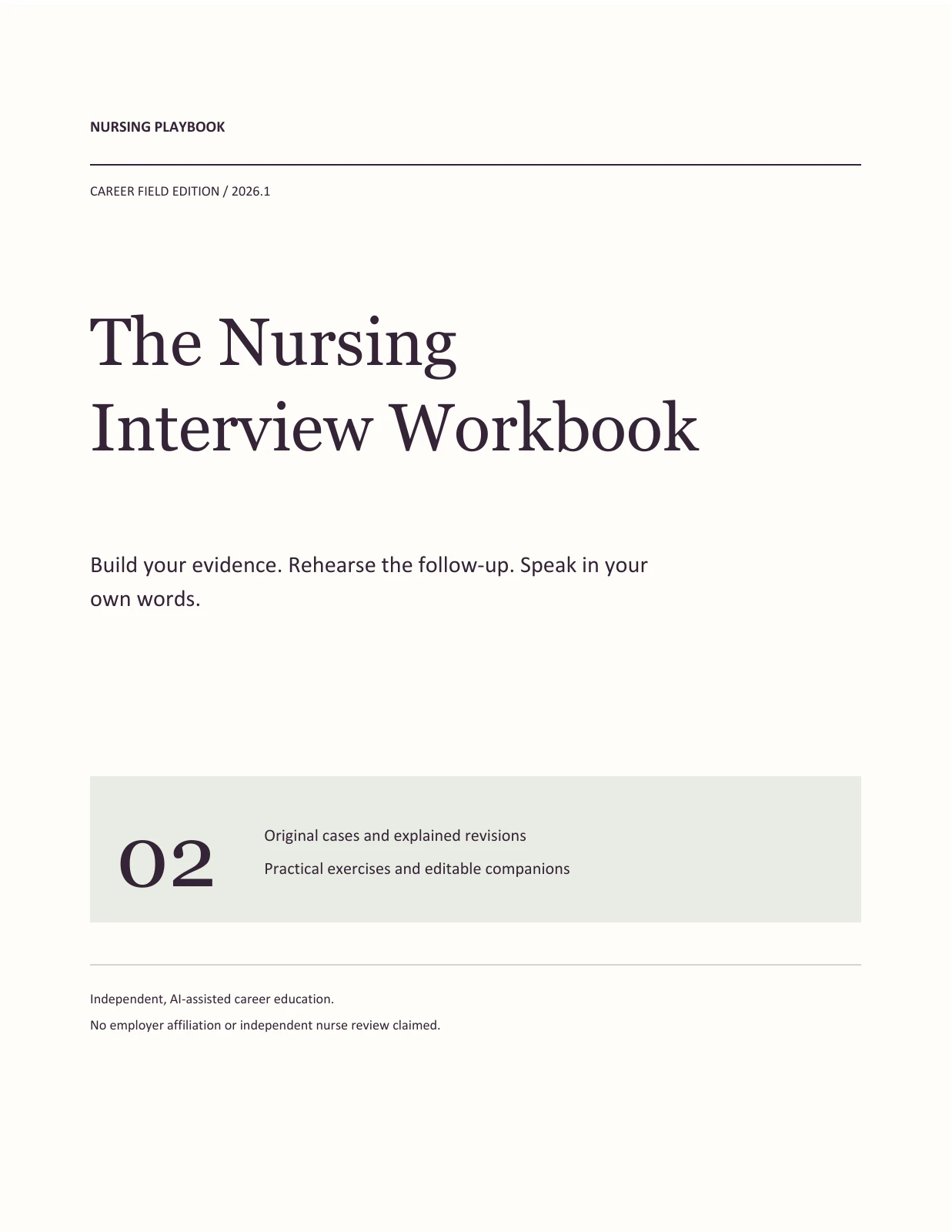
The Nursing Interview Workbook
The workbook extends this practice across 27 original exercises and three complete mock conversations, with four editable companions for independent rehearsal.
32-page PDF · 8-page free preview · Edition 2026.1
$39 USD one-time price. See the product page for current availability.
The free worksheet above is useful on its own. The book is self-directed career preparation; it does not include a personal review or determine eligibility.