Nursing Playbook / Practice in your own words
The Nursing Interview Workbook
Build a story bank, rehearse the follow-up, and ask questions that help you choose.
For first-role candidates who have experiences to discuss but need practice making their contribution, learning and interest clear.
Read before you decide
A real chapter.
Your own judgment.
8 pages from the 32-page book, edition 2026.1. The excerpt includes the cover, contents and at least one complete chapter. The remaining chapters and editable companions are not part of this sample.
Preview page 1 of 8. Use Enlarge page for a closer view. When the page is focused, use left and right arrows to change pages.
Read the complete free sample as text (8 pages)
Text from the same public sample shown above. Use the page images or PDF for diagrams, equations and original layout.
Sample page 1
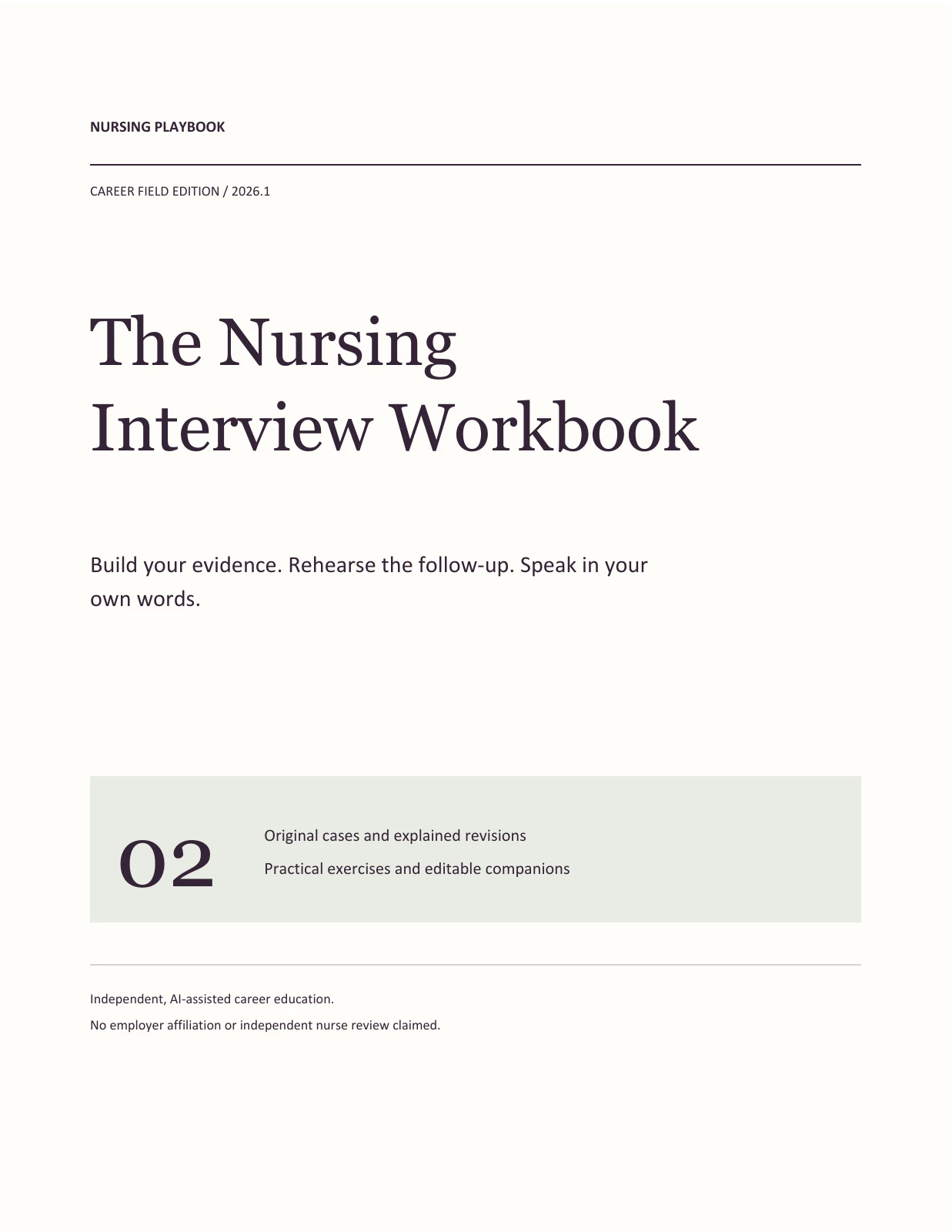
NURSING PLAYBOOK CAREER FIELD EDITION / 2026.1 The Nursing Interview Workbook Build your evidence. Rehearse the follow-up. Speak in your own words. 02 Original cases and explained revisions Practical exercises and editable companions Independent, AI-assisted career education. No employer affiliation or independent nurse review claimed.
Sample page 2
NURSING PLAYBOOK / 02 2026.1 The Nursing Interview Workbook 2 CONTENTS Your route through the work 4 1. Build a story inventory 7 2. Make an answer easy to follow 9 3. Feedback and learning 11 4. Teamwork and disagreement 14 5. Priorities and reliability 17 6. Motivation and role fit 19 7. Difficult follow-ups 22 8. Ask and listen 24 9. Three complete mock conversations 29 10. Run your own practice session 32 Source notes
Sample page 3
NURSING PLAYBOOK / 02 2026.1 The Nursing Interview Workbook 3 Practice in your own words Nursing Playbook · Career edition · Edition 2026.1 This workbook helps US nursing students and newly licensed nurses prepare for behavioral, motivation and role-fit conversations. It develops how you select an experience, explain your contribution and respond when a follow-up changes the direction. It does not teach clinical management or prepare you for every kind of nursing interview. Use your education, qualified instructors and the employer's instructions for clinical or technical preparation. All candidates, organizations and practice conversations here are fictional. The prompts are original exercises, not actual or leaked employer questions. A fictional answer is material to analyze, never a personal experience to claim. Nursing Playbook uses AI-assisted research and writing; this edition has not been independently reviewed by a nurse. A practice session should produce a revision Read a case, attempt the prompt, then compare your answer with the commentary. The model answer shows one defensible approach, not a phrase you must recite. Different wording is useful when it remains faithful to the facts and answers the question. After a practice attempt, write one specific change. “Be more confident” is not enough. “Name my own contribution before explaining the group result” is something you can do on the next attempt. Use the editable companion to keep the first attempt, feedback and revision together. ANA's general interview guidance supports preparation, role research and practice with concrete experience. Real employers can use different formats and question types. Confirm your own invitation and instructions; the mock sessions here do not predict an employer's process. [Sources 1 and 2]
Sample page 4
NURSING PLAYBOOK / 02 2026.1 The Nursing Interview Workbook 4 PRACTICE ROOM / 01 1. Build a story inventory Start with the experiences you remember accurately. Do not start with a list of impressive words and search for a story that could be made to fit. A small event with a clear decision can support a useful answer. A dramatic event in which your role is unclear may be much harder to explain responsibly. For each experience, note the setting, your role, the task, what you personally did, the outcome you actually know and what you learned. Add a boundary: what the experience does not establish. This is especially helpful when a student placement and paid employment appear in the same inventory. Both may be relevant, but their responsibilities are not interchangeable. Keep patient information, confidential workplace material and identifying details about other people out of your practice notes. You do not need to recreate a clinical record to explain how you received feedback or prepared for a learning activity. If an example depends on sensitive details to make sense, choose a different example for this workbook. Six experience notes Meet Lena, a fictional final-semester nursing student. The following notes are raw material, not finished answers. A. Simulation preparation. Lena helped a school group prepare for a simulation by compiling the instructor's equipment-preparation instructions into a shared checklist. Another student noticed that Lena had copied an older version of one instruction. Lena checked the current course material with the instructor, corrected the list and added a version date. She thanked the student for noticing it. No patient was involved. This is a preparation and correction example, not evidence of clinical proficiency. B. Placement debrief. During a supervised placement debrief, Lena's instructor said her update was difficult to follow because she mixed the order of events with her questions. Lena rewrote her own notes under those two headings and asked whether the revised organization was clearer. The instructor confirmed that it was. Lena continued preparing her questions separately for later debriefs. No clinical details are needed in the interview account. C. Student event. Lena and classmates organized a school information session. She was responsible for confirming the room and sharing the final time. A room change occurred, and she initially updated only the group chat. One classmate who was not in that chat missed the update. Lena contacted that person, revised the distribution list and used it for later messages. She cannot claim everyone received the first message or that every later message was acknowledged. D. Grocery employment. Lena worked part time at a grocery store. A colleague and she disagreed about who was handling an unfinished display. They compared the supervisor's assignment note, asked for clarification and divided the remaining work. Lena did not supervise the colleague.
Sample page 5
NURSING PLAYBOOK / 02 2026.1 The Nursing Interview Workbook 5 E. Observation. Lena watched an experienced nurse explain a task to another student. She admired the clarity but did not perform or lead the explanation. This may help explain an interest in learning; it does not demonstrate Lena's own teaching ability. F. Group result. Lena's class group received positive feedback on a presentation. She remembers editing two slides but cannot recall which changes she made. She needs to review her own work before using the event as an example of a specific contribution. Original practice 01: choose evidence for feedback Prompt: “Choose one experience that would help you explain how you responded to feedback. Why is it suitable, and what would you leave out?” A strong choice is B because the feedback, revision and response to the revision are identifiable. A is also defensible if the answer centers on correction after the outdated instruction was noticed. C could work if the candidate explains what she learned from the missed communication. There is no need to force a single correct story when several answer the question. A weak choice is E presented as Lena's own achievement. She can describe what she observed, but observation alone does not show her response to feedback. F is not ready because she cannot yet describe the contribution precisely. The next step is verification, not a more confident delivery. In a draft based on B, omit the content of the underlying clinical discussion. The relevant event is the organization of Lena's update and how she revised it. A listener needs enough context to understand the task, not private details that do no work in the answer. Original practice 02: separate action from outcome Prompt: “Use C to describe what Lena can honestly claim, then name one claim she should not make.” She can say she updated one channel, discovered the message had not reached a classmate, contacted that person and revised the later distribution list. She should not say she ensured flawless communication or prevented all future misunderstandings. The record supports a correction and a process change. It does not support perfection. An effective answer could acknowledge that the initial action was incomplete. That is not a reason to abandon the story. It gives the candidate a concrete opportunity to explain responsibility and learning. The mistake should remain proportionate: a school-event message is not recast as a clinical incident to sound more significant. Build your own inventory Write six notes from your own experience before composing full answers. Use one note each for a correction, a disagreement, a responsibility, a learning experience, an interest in the role and a difficulty that did not end perfectly. If a category has no suitable example yet, leave it open. You may identify one later through reflection or a conversation with a school career adviser. Mark each note “ready,” “verify” or “do not use.” Ready means you can explain the facts and limits without inventing details. Verify means a date, contribution or outcome needs checking. Do not use can mean the
Sample page 6
NURSING PLAYBOOK / 02 2026.1 The Nursing Interview Workbook 6 information is sensitive, the memory is too uncertain or the event does not actually support the proposed claim. Keep the inventory flexible One experience can answer several questions, but it should not answer every question in the same way. B can support feedback or communication. For feedback, emphasize what the instructor said and what changed. For communication, emphasize the difference between your first organization and the revised one. The facts stay fixed while the selection changes. Before moving on, ask a practice partner to read one note and tell you what they think you did. If they infer that you had authority you did not have, correct the note. This is easier before that ambiguity becomes a polished answer you have rehearsed repeatedly.
Sample page 7
NURSING PLAYBOOK / 02 2026.1 The Nursing Interview Workbook 7 PRACTICE ROOM / 02 2. Make an answer easy to follow An answer needs enough context for the action to make sense, but context can take over. Candidates often spend most of the response explaining the course, group or workplace and leave their own decision for the final sentence. Reverse the preparation order: identify the contribution first, then add only the background needed to understand it. A common situation-action-outcome structure can help you organize a first draft. It is a drafting aid, not a rule that every answer must sound like a labeled worksheet. In conversation, answer the question directly, explain the relevant event and stop when the point is clear enough for a follow-up. Try a 60-90 second first attempt during practice if a time limit helps you notice excess background. That is an exercise setting, not an employer standard. Some questions need a shorter answer; a recorded interview may impose its own limit. Follow the actual instructions. Original practice 03: shorten an opening Lena begins an answer about disagreement: I worked at a grocery store while I was in school, and there were lots of departments and different supervisors. We had different shifts depending on the week, and sometimes people were moved between areas. I had been there for a while, although not as long as some other people. One day there was a display, and it was a very busy time, and I thought someone else had been told to finish it. The opening spends time on details that do not yet explain the disagreement. A shorter version is: At my grocery job, a colleague and I each thought the other was responsible for finishing a display. I suggested we check the supervisor's assignment note before continuing the disagreement. The revision establishes the setting, shared misunderstanding and Lena's action. It does not need a full description of the store's staffing system. If the interviewer asks why the assignment was unclear, she can add the relevant detail then. Original practice 04: make “we” precise Draft: “We got organized, communicated well and finished the work.” The sentence may be true, but it gives no account of Lena's contribution. A revision is: “I suggested checking the assignment note. We then asked the supervisor to clarify the remaining work and agreed who would complete each part.” The first sentence identifies her proposal. The second preserves the shared action instead of claiming she alone solved the problem. Do not replace every “we” with “I.” That can turn a collaborative event into an inflated account. Use “I” for your action and “we” for the work genuinely done together. The distinction should survive follow-up questions.
Sample page 8
NURSING PLAYBOOK / 02 2026.1 The Nursing Interview Workbook 8 Original practice 05: close without a slogan Draft ending: “This taught me that communication is the key to success and teamwork makes everything possible.” A more useful ending is: “I learned to check the actual assignment before assuming a colleague had the same understanding I did.” The lesson is specific enough to affect future behavior. It also fits the scale of the event. Another valid ending could be: “After that, I confirmed the owner of unfinished work at handover instead of relying on an assumption.” Use that only if the candidate actually made the change. An attractive future behavior is not automatically a past fact. Put the answer together At my grocery job, a colleague and I each thought the other was responsible for finishing a display. I suggested we check the supervisor's assignment note rather than continue arguing from memory. The note did not settle every detail, so we asked the supervisor to clarify the remaining work and agreed who would complete each part. I learned to confirm responsibility for unfinished work instead of assuming we had the same understanding. This answer is concrete, but a listener could still ask what Lena did if the colleague initially disagreed. That is an opportunity to explain more, not proof that the first answer failed. Good preparation leaves you able to continue the conversation. Two more opening repairs Omar, a fictional career changer, starts: “I have always been a leader, and throughout my professional life I have been involved in many situations that demonstrate my ability to deal with complex issues.” A better opening names one situation: “In my previous warehouse job, I found that a handover sheet listed two different collection times.” The listener can now follow a decision. Nia, a fictional newly licensed applicant, starts: “Since I am new and have not had the same experience as other nurses, I do not know if this is a good example, but…” A clearer opening is: “A relevant example from my final school project is…” She can label the setting without apologizing for it. If the question specifically requires experience she does not have, she should say that directly and ask whether a related example would be useful. A revision method you can repeat Underline the sentence that answers the question and move it earlier if needed. Circle your action, then mark the known outcome and learning. If an action is missing, return to the inventory. Read the revision aloud and split cumbersome sentences. Keep necessary limits; do not remove them merely to sound certain.
Choose by the work in front of you
Is this your next step?
Choose this when you need a repeatable rehearsal process, including follow-up questions and guidance for reviewing your own answers.
Career and behavioral interview preparation. It does not teach clinical decision-making, provide exam preparation or replace an employer's instructions for clinical assessments.
Inside the manuscript
A route through
the work.
10 sections with original examples, explanations and practice. Contents reflect the released edition.
- Build a story inventory
- Make an answer easy to follow
- Feedback and learning
- Teamwork and disagreement
- Priorities and reliability
- Motivation and role fit
- Difficult follow-ups
- Ask and listen
- Three complete mock conversations
- Run your own practice session
How the book approaches the problem
Rehearse the second question, too.
A practiced answer can sound convincing until someone asks what you personally did or what changed after feedback.
The manuscript includes 27 original exercises and three worked mock conversations. The practice separates the candidate's actions from the team's work, explores follow-ups and explains revisions. These are teaching exercises, not a leaked or verified employer question bank.
Original teaching material. Fictional cases are identified in the book. This description is not the PDF preview.
Keep working after reading
Editable companions.
Editable plain-text Markdown and spreadsheet-compatible CSV files. Paste text into Word or Google Docs and format it there; these are not preformatted Word documents. Use your own private copies; these files do not submit applications or synchronize with employers.
- Story inventory (CSV)
- Practice-session worksheet
- Role and employer-question sheet
- Mock-interviewer cards
About the preparation.
Created by Nursing Playbook using AI-assisted research and writing, original cases and linked source notes. No independent nurse review, employer affiliation or hiring guarantee is claimed.
Read our editorial approach