Nursing Playbook / A deliberate career transition
Bedside to Remote Nursing
Compare the work behind remote titles, check restrictions and translate your bedside experience without overstating it.
For experienced US nurses considering remote care coordination, review work or an adjacent career transition.
Read before you decide
A real chapter.
Your own judgment.
5 pages from the 17-page book, edition 2026.1. The excerpt includes the cover, contents and at least one complete chapter. The remaining chapters and editable companions are not part of this sample.
Preview page 1 of 5. Use Enlarge page for a closer view. When the page is focused, use left and right arrows to change pages.
Read the complete free sample as text (5 pages)
Text from the same public sample shown above. Use the page images or PDF for diagrams, equations and original layout.
Sample page 1
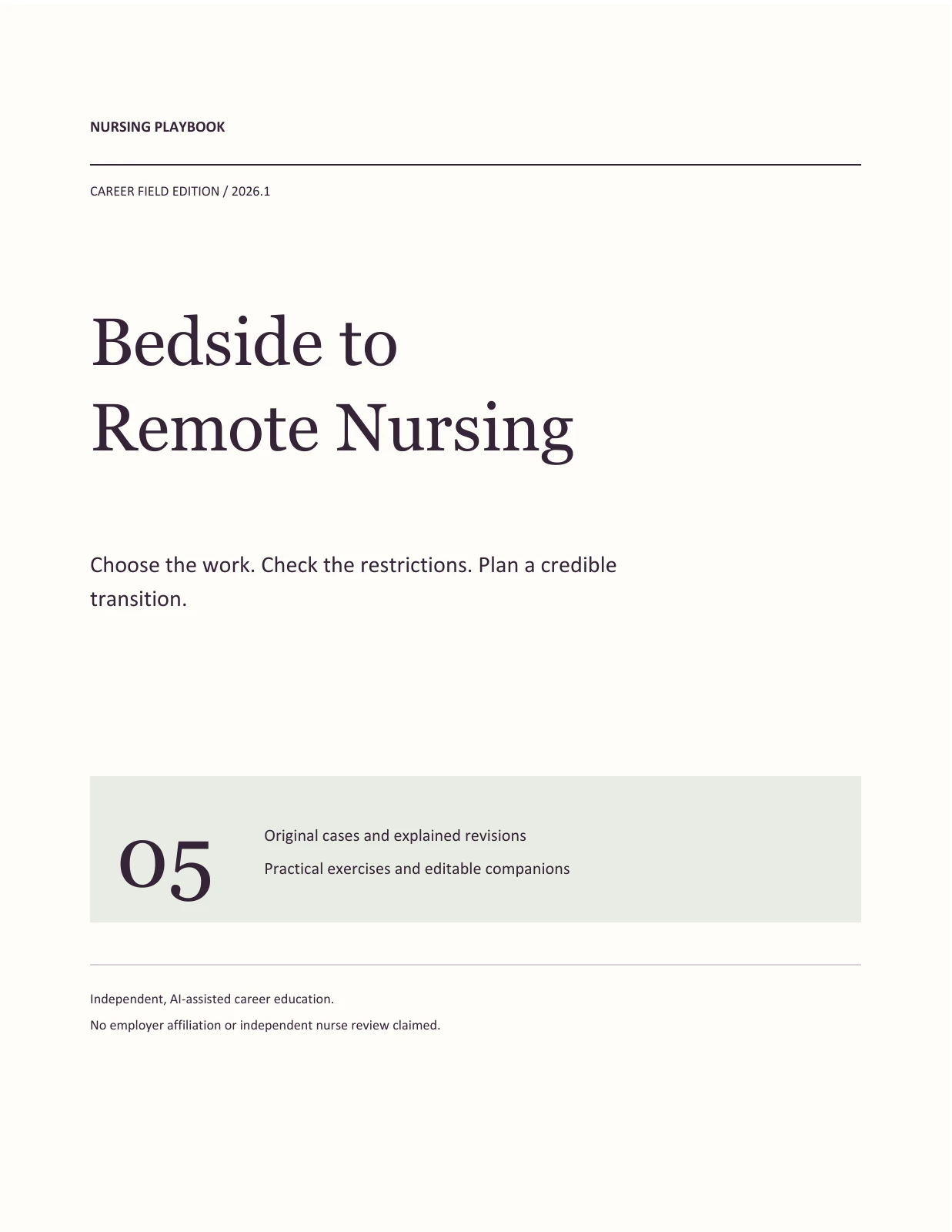
NURSING PLAYBOOK CAREER FIELD EDITION / 2026.1 Bedside to Remote Nursing Choose the work. Check the restrictions. Plan a credible transition. 05 Original cases and explained revisions Practical exercises and editable companions Independent, AI-assisted career education. No employer affiliation or independent nurse review claimed.
Sample page 2
NURSING PLAYBOOK / 05 2026.1 Bedside to Remote Nursing 2 CONTENTS Your route through the work 4 1. Choose the work before the location 6 2. Check the restrictions before investing in an application 8 3. Translate bedside evidence without renaming your job 10 4. Close the gap that matters to a real target 11 5. Build a packet for one work family 12 6. Run a search you can learn from 13 7. Prepare for the conversation behind the title 14 8. Compare offers on the same basis 15 9. Run a 30-day transition experiment 16 10. Work through Elena's decision 17 Sources and edition boundaries
Sample page 3
NURSING PLAYBOOK / 05 2026.1 Bedside to Remote Nursing 3 Career edition 2026.1. A practical transition playbook for experienced US nurses. Nursing Playbook. This guide helps you choose the work behind a remote title, check whether a role is plausible for you, translate your real experience and run a focused application process. Your outputs are a role shortlist, an evidence map, a gap plan, a target-specific application, interview notes and an offer comparison. Six editable companions support those decisions. This is not a list of guaranteed openings, a clinical course, a certification program or a promise that a bedside background qualifies you for every remote role. It does not assess your individual license or provide legal or tax advice. The examples are original fictional teaching cases. No patient records are needed. The book is independently produced with AI-assisted research and writing; no employer affiliation or independent nurse review is claimed. Read chapters 1 and 2 before spending money on another credential or rewriting your resume. Use chapters 3-6 to prepare and search. Chapters 7-10 take you through conversations, comparisons and a bounded application experiment. If you are newly licensed, use the eligibility screen especially carefully: the reader assumed here already has nursing work experience, and many transitions depend on responsibilities you may not yet have held. Remote is a location arrangement. It does not by itself establish low workload, flexible hours, nonclinical work or permission to work from anywhere. Your goal is to find a role whose actual requirements and conditions fit your experience and priorities.
Sample page 4
NURSING PLAYBOOK / 05 2026.1 Bedside to Remote Nursing 4 CAREER TRANSITION / 01 1. Choose the work before the location Begin with the tasks you want to do more often. Do you prefer sustained coordination, structured record review, explaining information, improving systems or organizing a defined process? Then examine how those tasks appear in employer descriptions. Searching only for “remote nurse” produces a mixed set of roles that can require very different evidence. The following descriptions are a search map, not a universal classification of nursing jobs. Employers combine tasks differently. The current posting and hiring team's explanation matter more than a title used elsewhere. Search family Questions to investigate Care coordination or case management What population and caseload? How much telephone contact, follow-up, field work and documentation? Utilization or clinical review What type of review, decision authority, criteria training and escalation process? Documentation or quality roles What review experience, coding knowledge, audit responsibilities or credentials are actually required? Telephone or virtual care What patient contact, schedule, supervision, licensure and escalation arrangements apply? Informatics or clinical systems Is the work end-user support, training, workflow analysis, configuration or implementation? ANA describes informatics as work connecting nursing with information systems, with activities that can include workflow improvement, implementation and education. This does not establish that those roles are remote or that routine EHR use qualifies someone for a specialist position. [Source 1] Separate what you want to leave from what you want to do Wanting a different commute or schedule is a legitimate preference. It is not enough to choose a job. Write two lists: conditions you need to change and tasks you are willing to perform repeatedly. A role can remove a commute while introducing scheduled calls, performance targets or unfamiliar administrative work. Fictional nurse Elena has five years of bedside experience and wants fewer commuting days. She enjoys coordinating with other teams but dislikes spending an entire day on the telephone. Instead of assuming that every care-management role fits, she asks about contact volume and the balance of calls and documentation. The answer may still be acceptable, but it is a decision rather than a surprise. Fictional nurse Marcus likes checking whether a packet contains the information needed for a next step. He is curious about review work. That preference gives him a reason to investigate, not proof that he knows a payer's review criteria or has authority to make coverage decisions.
Sample page 5
NURSING PLAYBOOK / 05 2026.1 Bedside to Remote Nursing 5 Build a target sentence Use this original working format: “I am investigating [work family] because I can demonstrate [related contribution], and I need to verify [largest gap or restriction].” Elena's version might be: “I am investigating care-coordination roles because I can demonstrate interdisciplinary discharge communication, and I need to verify the required case-management experience and daily call expectations.” This sentence keeps your research focused. It also prevents a common mistake: buying training for a broad label before you know the work. Start with one primary family and one adjacent option. You can expand later if the evidence supports it. First exercise Choose three employer postings and describe each role without using the word remote. If all you can say is “work from home,” you have not extracted enough information. Write the main output, the people contacted, a stated requirement and a question. A useful shortlist contains differences you can act on, not only links. The role-screen companion stores those differences. Keep the employer URL and date checked. Postings change or disappear; a saved research note is a dated snapshot, not an assurance that a vacancy is still open. Your target brief Use this space for a first draft, then transfer the useful detail to the companion. A work family should describe tasks, while the restriction describes a condition you need to verify. Primary work family: ___________________________________________ Task I want to do more often: ___________________________________ Actual contribution that supports this direction: __________________ ________________________________________________________________ Largest unanswered restriction or gap: ___________________________ ________________________________________________________________ Official source I will check next: _______________________________ What answer would change my target: ___________________________
Choose by the work in front of you
Is this your next step?
Choose this when you need to distinguish plausible remote roles from attractive titles, and make an application plan grounded in your actual experience.
Career planning for experienced US nurses. No clinical training, certification, personal licensure assessment, ongoing vacancy updates or hiring guarantee. The 30-day plan is a preparation window, not a job promise. Sold separately from the First-Role Library.
Inside the manuscript
A route through
the work.
10 sections with original examples, explanations and practice. Contents reflect the released edition.
- Choose the work before the location
- Check restrictions before investing in an application
- Translate bedside evidence without renaming your job
- Close the gap that matters to a real target
- Build a packet for one work family
- Run a search you can learn from
- Prepare for the conversation behind the title
- Compare offers on the same basis
- Run a 30-day transition experiment
- Work through Elena's decision
How the book approaches the problem
Remote is a location, not a job description.
Fictional nurse Elena compares three roles: one may accept related experience, one excludes her location, and one requires specialist experience she does not have.
The book follows her screening, truthful resume revision, employer questions and offer comparison. A dated employer example also shows why unclear credential wording deserves a question rather than a guess.
Original teaching material. Fictional cases are identified in the book. This description is not the PDF preview.
Keep working after reading
Editable companions.
Editable plain-text Markdown and spreadsheet-compatible CSV files. Paste text into Word or Google Docs and format it there; these are not preformatted Word documents. Use your own private copies; these files do not submit applications or synchronize with employers.
- Role screen (CSV)
- Evidence map with a fictional worked row
- Target-specific gap plan
- Outreach and interview worksheet
- Offer comparison (CSV)
- Completed fictional transition case
About the preparation.
Created by Nursing Playbook using AI-assisted research and writing, original cases and linked source notes. No independent nurse review, employer affiliation or hiring guarantee is claimed.
Read our editorial approach