Nursing Playbook / A working session
Make your interest specific and supportable.
Build a unit-interest answer from an employer source, your own experience and one question that still needs an answer.
Build the connection before the sentence
A useful motivation answer rests on a connection between what the employer describes and what matters to you. It should remain accurate if the interviewer asks where you learned that detail or explains that your understanding is incomplete.
This session gives you a source-and-evidence note, a worked answer and a revision after new information. The employer, unit and candidate below are invented. They demonstrate a preparation method, not a verified feature of a real nursing program.
The working case: Alex researches a role
Alex is a fictional final-term student considering an invented medical-surgical new-graduate role. The posting describes scheduled learning reviews during orientation. A separate hospital page describes a broader education program, but it does not say whether every part applies to this unit.
In Alex's course work, bringing a written question to an instructor meeting helped focus the discussion. Alex wants to understand how a new graduate asks for feedback in this role. Alex has not worked on the unit and has not spoken with its staff.
The initial notes contain three different kinds of information:
On a narrow screen, scroll the table sideways to read each column.
| Note | What supports it | How to use it |
|---|---|---|
| Scheduled learning reviews during orientation | The fictional role posting | Refer to the posting; ask how reviews work |
| Written questions helped focus a course meeting | Alex's own experience | Explain the personal connection in its original setting |
| Everyone on the unit is supportive | No evidence in the case | Remove the claim rather than present it as fact |
The hospital-wide education page belongs in a separate question until its relevance is established. It cannot automatically be described as a benefit included in this particular role.
Draft a bounded answer
Alex's first draft says:
“I know your unit is incredibly supportive, and the education program will give me everything I need.”
The draft turns an advertised structure into a broad promise. A revised answer could be:
“The posting's description of learning reviews during orientation interested me. In a course meeting, I found that bringing a specific question helped me use the feedback more deliberately. I would like to understand how new graduates prepare for those reviews here and who they speak with when they need clarification.”
This answer has a source, a personal connection and an unanswered question. It is specific without claiming that Alex has already experienced the unit's culture or knows the support will suit every need.
Revise when the interviewer adds information
In the fictional conversation, the interviewer explains that the timing of reviews depends on the orientation plan. Alex had assumed that “scheduled” meant a fixed weekly meeting, but that frequency was never stated in the posting.
A useful response is: “Thank you for clarifying that. I had not confirmed the timing. How does a new graduate know when to raise a question between the planned reviews?”
Alex updates the note: review timing depends on the plan; route for questions between reviews still needs clarification. There is no reason to defend the original assumption. The conversation has supplied better information.
Adapt the exercise when no unit is assigned
If the application is hospital-wide or the unit is selected later, discuss the opportunity at that level. Do not pretend to have chosen a unit that is not part of the current process. A useful question may concern how preferences are considered or when the assignment becomes known, provided the answer is not already in the instructions.
If your interest comes from a supervised placement, keep that setting and role visible. If you have no direct exposure, name the source of your interest and the questions you are exploring. Neither situation requires inventing a personal history.
Make your own source-and-evidence note
Download the worksheet and record one employer detail with its source and review date. Add one personal experience that explains why it matters to you. Then write what the source does not establish.
Draft the answer in your own words and ask a practice partner two questions: “Which statement could I verify from the employer source?” and “What am I still assuming?” If either is unclear, improve the distinction before rehearsing again.
Use the unit-interest guide for a shorter version, then save a draft in the rehearsal room. If you need to compare this role with another, use the first-role comparison session. An appealing feature is a reason to investigate, not a guarantee of fit.
If you need the wider process
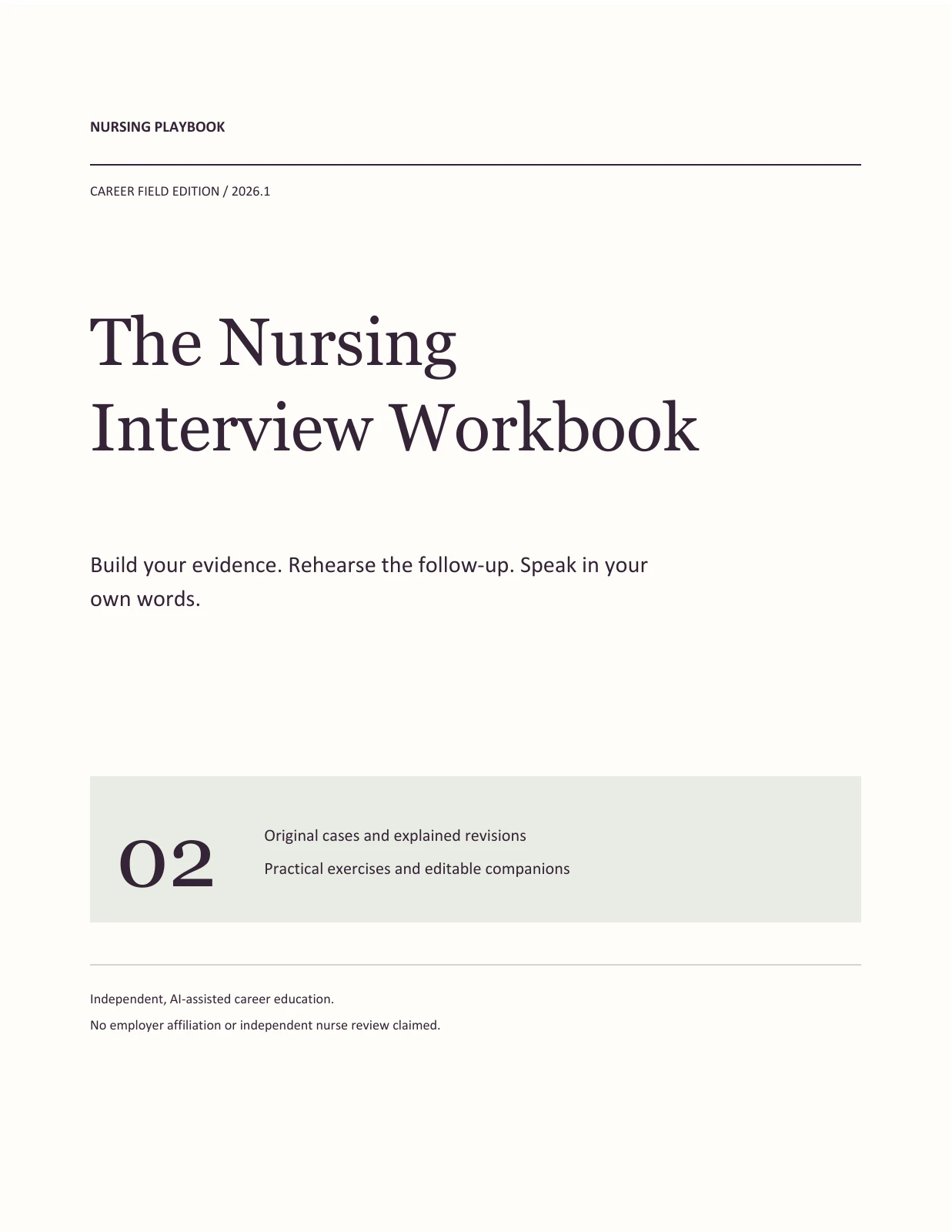
The Nursing Interview Workbook
The workbook connects motivation with a personal story bank, difficult follow-ups and questions for the employer. Its four editable companions help organize repeat practice.
32-page PDF · 8-page free preview · Edition 2026.1
$39 USD one-time price. See the product page for current availability.
The free worksheet above is useful on its own. The book is self-directed career preparation; it does not include a personal review or determine eligibility.